Welding is a job where danger rarely comes from a single source. Sparks, molten metal splashes, thermal radiation, hot parts, sharp edges, heavy workpieces, and contaminated coatings are all present. Therefore, a good welder's kit is not a collection of individual items, but a system: each element should address a specific risk and not interfere with other protective equipment.
The main mistake is choosing equipment based on the principle of “it looks like work equipment.”. For welding work, proven protective properties, footwear and clothing design, proper fit, and compatibility of the entire kit are important.
Why regular work gear isn't enough
Regular boots may be durable and comfortable, but that doesn't make them suitable for welding. Exposed lacing collects scale, synthetic components can be damaged by sparks, and soles without proven heat resistance aren't designed for contact with hot surfaces.
The same applies to clothing, gloves, and face protection. A welding kit should take into account the intensity of the process, body position, whether the work is indoors or outdoors, the availability of ventilation, the season, and any additional mechanical risks. There is no one-size-fits-all kit for all sites.
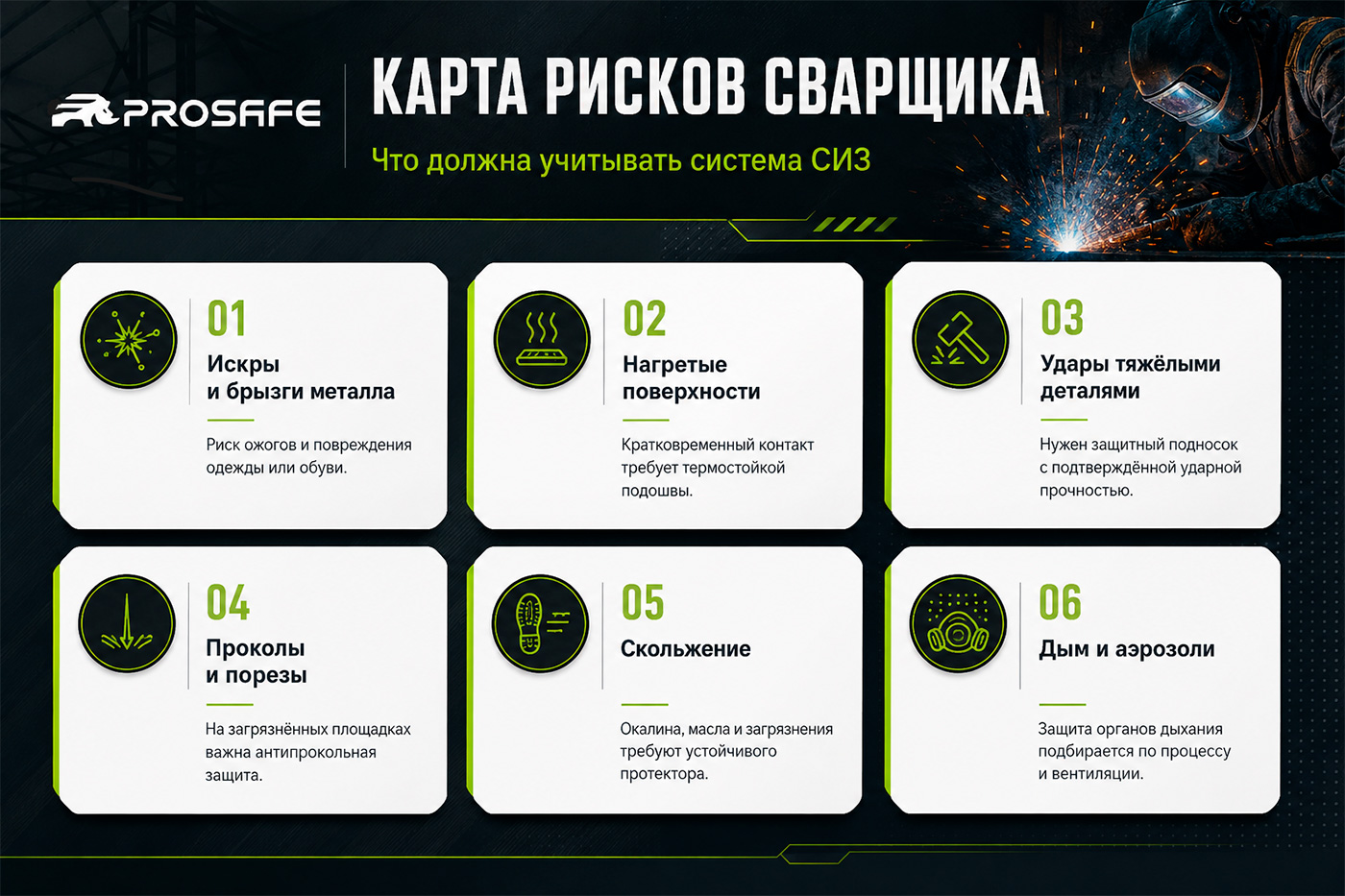
Mistake 1: Choosing PPE without a risk map
You shouldn't start with the catalog, but with the working conditions. For one welder, the main risk will be sparks and metal spatter, while for another, it might be working at height, confined spaces, oil on the floor, or handling heavy parts. If the risks aren't prioritized, you could buy an expensive kit that doesn't address the main hazard.
Before selecting, please note:
-
type of welding process and intensity of sparks and spatter formation;
-
temperature of parts and the likelihood of contact with a heated surface;
-
presence of sharp objects, metal shavings and risk of puncture;
-
floor condition: oil, water, scale, smooth metal or concrete;
-
season, air temperature and duration of shift;
-
the need to work at height or in a confined space.
Mistake 2: Thinking that one element will replace the entire set
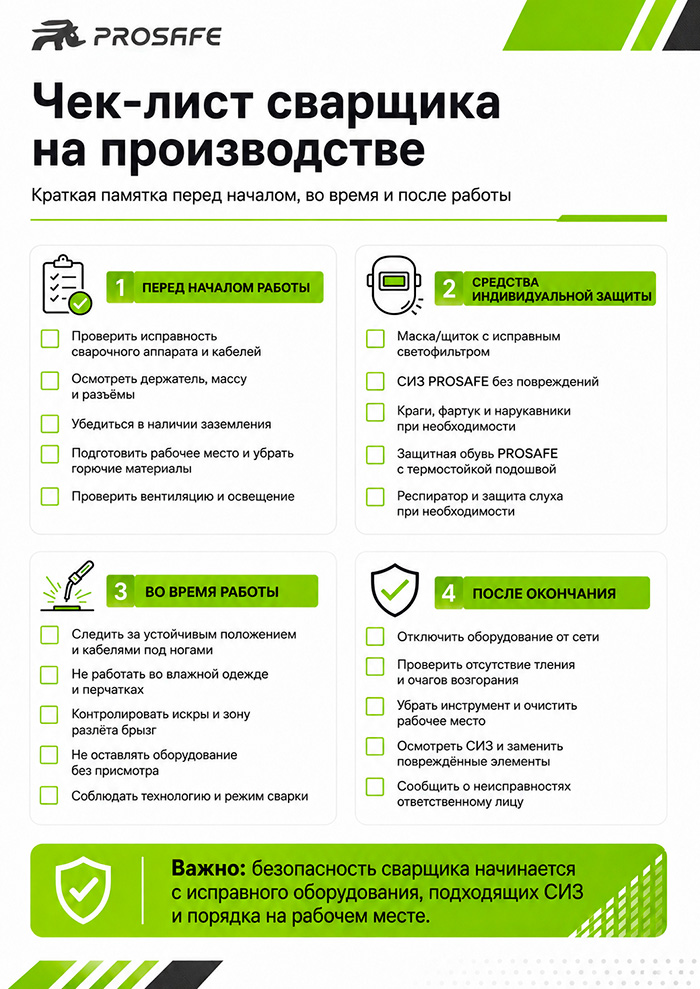
Even the best footwear doesn't protect the eyes, respiratory tract, or hands. A welder's kit typically includes special clothing, gloves or mittens, a mask or visor, eye, respiratory, and hearing protection, and, if necessary, an apron, arm protectors, a balaclava, and a safety harness. The specific kit is determined based on a risk assessment.
Mistake 3: Buying "heat-resistant" boots without checking the label
The words "for hot work" in the description are insufficient. The product data sheet, certificate, and labeling should specify specific protective properties. The following designations are especially important for welder's footwear:
|
Designation |
What does it mean? |
Why is it important for a welder? |
|
Tr |
Protection against sparks, splashes of molten metal and scale |
Covers the typical risks of welding and hot work. |
|
Tp |
Protection against contact with hot surfaces |
For PROSAFE Series 24 models, short-term contact resistance up to +300 °C is specified. |
|
MUN200 |
Toe protection against 200 J impact |
Reduces the risk of injury when a heavy part falls. |
|
MP |
Puncture protection |
Important in areas with shavings, sharp cuttings and fasteners. |
|
Sz / Sm |
Slip resistance on dirty surfaces |
Helps maintain stability on the production floor. |
Mistake 4: Leaving the laces open
The exposed lacing area is susceptible to sparks and scale. Therefore, a protective front flap is used for welding. It covers the lacing and reduces the risk of hot particles getting inside.
Important: The valve should close completely, not bend when walking, and allow you to quickly remove your shoes if necessary.
Mistake 5: Confusing metal and composite toe caps
Both options can provide up to 200 J of toe protection, if documented. A metal toe cap is the traditional solution, while a composite toe cap reduces the number of metal parts and is typically lighter. The choice depends on the site conditions, security requirements, and worker preferences.
Don't choose a toe cap based solely on the material. More important are proven impact resistance, the correct size, and the absence of pressure on the toes during prolonged wear.
Mistake 6: Not considering the risk of puncture
In the welding area, metal scraps, wire, fasteners, and sharp parts may be left on the floor. If this risk exists, footwear with certified puncture protection is required. This can be metallic or non-metallic—the type is selected based on the production conditions and metal-free requirements.
Mistake 7: Buying one model for the whole year
Demi-season footwear is suitable for heated spaces and moderate conditions, but in winter, insulated footwear is required for outdoor work. However, the insulation should not interfere with proper fit, and employees should not be given shoes that are obviously tight to wear.
|
Conditions |
What to consider |
Example solution |
|
Heated workshop |
Heat load, ventilation, shift duration |
Demi-season model with textile lining. |
|
Cold shop / street |
Temperature, wind, contact with snow and moisture |
Winter model with artificial or wool fur. |
|
Mixed mode |
Frequent street-to-premises transitions |
Balance of insulation, weight and moisture management. |
Mistake 8: Ignoring fit and actual fitting
The protective properties of shoes are not fully effective if they are too big, too small, or do not provide adequate support. Shoes that are too loose reduce stability, while shoes that are too tight put pressure on the toes and reduce stability during long shifts. Shoes should be tried on with the socks the employee will be wearing at work.
When wearing them for a while, evaluate the heel support, freedom of movement of the toes, absence of toe pressure, sole flexion, and ease of quick removal.
Mistake 9. Not checking PPE before each shift
A burn, a cracked sole, a delamination, a damaged valve, or a worn tread can negate the benefits of a properly selected model. The inspection should be brief, clear, and consistent for the entire team.
Which PROSAFE footwear should you consider for welding?
The PROSAFE welding footwear website features models from the 24 series. They feature genuine leather, a protective front flap, a dual-layer PU/nitrile sole, and protective properties such as Tr and Tp. The choice of a specific model depends on the season and toe cap requirements.
|
Model |
Season |
Toe cap |
Insulation |
Key emphasis |
|
24 |
Demi-season |
Metal |
No |
Classic model with front flap. |
|
24M |
Winter
|
Metal
|
Faux fur |
For cold conditions and welding work, as well as protection of Tr and Tp. |
|
24 km |
Winter |
Composite |
Faux fur |
For cold conditions and welding work. |
|
24KNM-1 |
Winter |
Composite |
Woolen fur |
Winter model with natural wool insulation. |
Practical procurement algorithm
1. Create a risk map for specific workplaces.
2. Determine the required protective properties and seasonality.
3. Select only models with confirmed markings and documents.
4. Conduct a fitting and trial wear on a small group.
5. Collect feedback from welders and site foremen.
6. To approve the rules for inspection, care and replacement of footwear.
Conclusion
Welding shoes are not a separate purchase, but part of a safety system. The protective valve, Tr and Tp properties, toe cap, puncture protection, durable tread, seasonality, and proper fit all work together. This approach helps not only meet requirements, but also make the equipment understandable and comfortable for the people who use it every day.
Frequently Asked Questions
What kind of shoes are suitable for a welder?
This model features proven protection against sparks and molten metal splashes, a heat-resistant sole, a protective toe cap and a design that covers the laces.
What does Tr mean in shoe markings?
Protection against sparks, splashes of molten metal and scale.
What does Tp mean?
Protect against contact with hot surfaces. The permissible temperature should be specified in the documentation for the specific model.
Is a metal or composite toe cap better?
Both options are suitable if impact resistance is confirmed. The choice depends on the site conditions, weight, requirements for metal components, and convenience.
Can I use regular work boots?
Only if their protective properties and design correspond to the risks of the welding area and are confirmed by documents.